
During a civil wedding at the town hall, it is often thought that the mayor reads everything, from the first to the last word. In practice, the reading of the marriage certificate and the articles of the Civil Code involves several participants, and the distribution of roles varies depending on the size of the municipality and the internal organization of the civil status service.
Delegation of the reading of the act: who actually intervenes in the wedding hall
In a small municipality, it is often the town hall secretary who reads the marriage certificate while the elected official officiating manages the ceremony’s proceedings. This distribution is not trivial: when the usual secretary is absent (due to leave, illness, or even their own wedding), the question arises as to who can replace them.
On this point, the reading of the act is not an act of public authority. It does not constitute the collection of consent nor the declaration of union. In practice, any person present in the room can read the act aloud, including a relative of the couple or a municipal agent from another municipality. What matters legally is that the civil status officer (the mayor, a deputy, or a delegated municipal councilor) pronounces the declaration of union and collects the consents.
To delve deeper into the legal framework of this distribution, one can refer to the reading of the article of the civil code on Espace Mariage, which details the applicable texts.
Civil status officer and reading the articles of the Civil Code: two distinct functions
Two moments of the civil ceremony are often confused: the reading of the articles of the Civil Code relating to the rights and duties of spouses, and the reading of the marriage certificate itself (which summarizes the identity of the spouses, witnesses, chosen matrimonial regime, etc.).
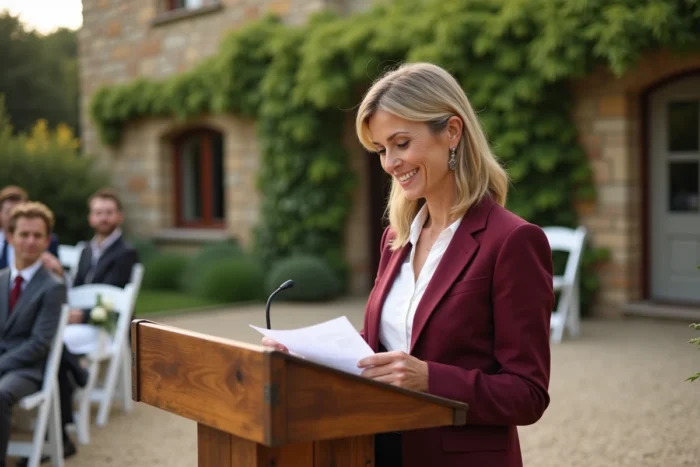
Only the civil status officer is required to read the articles of the Civil Code to the future spouses. Article 75 of the Civil Code mandates this reading before collecting consent. The civil status officer is the mayor, a deputy, or a municipal councilor who has received delegation. In large cities, specifically authorized territorial officials increasingly perform this function, reflecting a professionalization of the officiant’s role.
The reading of the marriage certificate (the summary document signed at the end of the ceremony) falls under an administrative practice, not a personal obligation of the officer. This is where the town hall secretary, an agent, or even a third party most often intervenes.
What the officer cannot delegate
- The collection of the spouses’ consent (the solemn “yes”): an exclusive act of the civil status officer
- The official declaration of union in the name of the law: only the officer pronounces the formula that unites the spouses
- The signing of the act in the capacity of officer: it engages their administrative responsibility
Everything else in the proceedings (reading the act aloud, introducing the witnesses, welcome speech) can be entrusted to another person.
Wedding witnesses and relatives: can they read a text during the civil ceremony?
The witnesses have a specific role during the civil wedding: they attest to the reality of the celebration and sign the act. Their presence is mandatory (a minimum of two, a maximum of four). However, nothing prohibits a witness from reading the marriage certificate or another text during the ceremony, provided that the civil status officer accepts it.
In practice, feedback varies on this point. Some town halls apply a strict procedure where only municipal staff read official documents. Others, particularly in small municipalities, willingly accept that a relative takes charge of reading the act to give a more personal touch to the ceremony.
When a relative reads the act: precautions to take
If the reading of the act is entrusted to a relative or a witness, a few points deserve attention:
- The act must be read in full or in the version validated by the civil status officer, without modification or omission of mandatory mentions
- The person reading has no legal responsibility related to this reading; they do not substitute for the officer
- The civil status officer remains present and supervises the proceedings; they take over for collecting consent and the declaration of union
Thus, a clear distinction is made between reading aloud (a material task) and acts of public authority (consent, declaration, official signature).
Full or abbreviated reading of the marriage certificate: what the town hall can adapt
A frequent question concerns the length of the reading. Article 75 of the Civil Code mandates the reading of certain articles relating to the obligations of spouses. For the marriage certificate itself (the signed document), a synthetic reading is common in the majority of town halls.
The civil status officer or the designated person focuses on the main mentions: full identity of the spouses, date and place of birth, matrimonial regime, identity of the witnesses. More administrative mentions (act numbers, references for the publication of bans) are often omitted in oral reading, while still appearing on the written document.
This flexibility in reading allows for adapting the ceremony to the available time, especially in urban municipalities where several weddings take place on the same day. The civil status officer retains the responsibility to ensure that all legal mentions are present on the written act, even if not all are read aloud.
The legal framework of civil marriage thus allows for more leeway than one might imagine regarding the reading. The civil status officer remains the sole guarantor of the legal validity of the ceremony, but the reading of the act can be entrusted to an agent, a witness, or a relative, depending on local customs and the wishes of the couple.