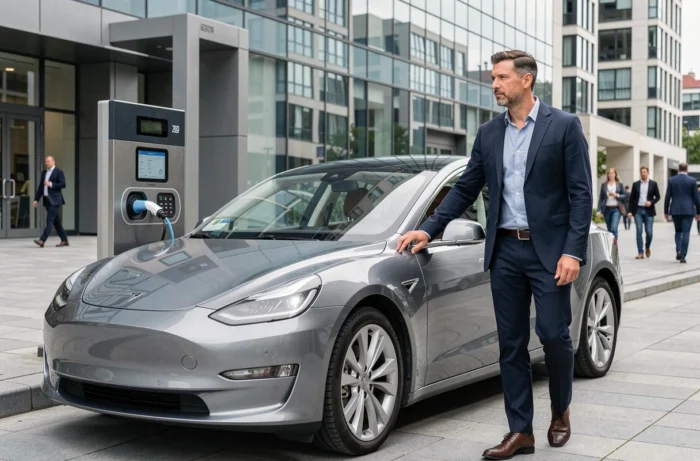
The French automotive market is contracting in the new car segment, while sales of electric vehicles are rising again. This simultaneous movement reflects a profound restructuring of the sector, not just a simple transition from one engine to another. Understanding the future prospects for the automobile requires looking beyond the engine, towards changing standards, batteries, and usage.
Euro 7 Environmental Passport: What Changes for Buyers
Have you ever bought a phone by checking the condition of its battery? The same instinct will apply to new cars. Starting from November 29, 2026, every new type of car sold in the European Union will have to include a vehicle environmental passport. This digital document will display, among other things, the health status of the traction battery.
The obligation will then extend to all new cars from November 29, 2027. In practice, this means that a buyer will be able to consult reliable data on the actual capacity of the battery before purchasing, including in the used car market.
Euro 7 is not limited to exhaust emissions. The standard now imposes minimum durability thresholds for batteries, verifiable after 5 years and 100,000 km, and then after 8 years and 160,000 km. A manufacturer selling an electric vehicle must ensure that its battery retains sufficient capacity at these two milestones.
For motorists, this is a major change. Until now, battery degradation remained a gray area, a source of legitimate concern. With these regulatory requirements, battery lifespan becomes a measurable and comparable criterion between brands.
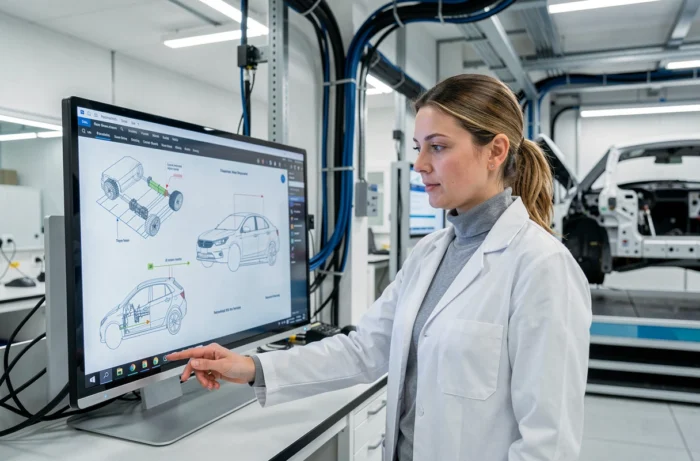
Electric Vehicles in 2026: Why the Market is Restructuring Rather Than Growing
Registrations of new passenger cars in France fell in 2025 compared to 2024, according to data from SDES (Service for Data and Statistical Studies on Sustainable Development). At the same time, sales of electric vehicles are rising again in 2026.
This discrepancy deserves a simple explanation. The market is not growing; it is redistributing. Buyers switching to electric are not adding to the total volume. They are replacing buyers of combustion vehicles who are either postponing their purchase or turning to used cars.
Why this postponement? Several factors are at play:
- The average price of new cars remains high across all powertrains, pushing some households towards the second-hand market.
- Regulatory uncertainties (driving bans, low-emission zones) hinder the purchase of a new combustion vehicle without immediately triggering a switch to electric.
- The supply of affordable electric vehicles is gradually expanding but remains insufficient to absorb all the demand leaving the combustion segment.
The result is a restructuring market where the share of electric vehicles is mechanically increasing, even as the overall volume stagnates or declines.
Batteries and Lithium Technology: The Real Issue Behind Powertrains
When we talk about electric vehicles, we first think of the engine. The component that truly determines the future of the sector is the battery. Its chemistry, cost, lifespan, and recycling condition everything else.
Lithium-ion technology currently dominates production. It powers nearly all electric vehicles sold in Europe. But lithium poses a supply and industrial sovereignty problem. Extraction is geographically concentrated, and the processing of raw materials largely depends on a few players.
This is where the circular economy comes into play. Recycling end-of-life batteries to recover lithium, cobalt, and nickel could reduce this dependency. Several European manufacturers, including Renault, are investing in recycling channels on the continent.
What Euro 7’s Durability Requirements Change
The regulatory durability thresholds (5 years / 100,000 km, then 8 years / 160,000 km) will push manufacturers to select more robust battery chemistries. A battery designed to last longer is also easier to recycle, as it retains more usable active material at the end of its cycle.
This link between durability and recyclability is not immediately obvious. However, it explains why Euro 7 regulations go beyond mere pollutant emissions to touch on the entire automotive value chain.

Automotive Innovation and Autonomous Driving: Where Do We Really Stand?
Autonomous vehicles have been part of the media landscape for about a decade. The reality of deployment is more nuanced than the announcements. Driver assistance systems (emergency braking, lane keeping, adaptive cruise control) are becoming standard on new models. Fully autonomous driving, without human intervention, remains confined to localized experiments.
For the automotive industry, value is shifting from hardware to software. A modern vehicle is equipped with hundreds of sensors and millions of lines of code. Remote software updates allow for the addition of features after purchase, transforming the car into an evolving product.
This evolution has a direct impact on the sector’s subcontractors. Suppliers of traditional mechanical parts are losing ground to specialists in embedded electronics and data processing. Automotive innovation now relies as much on code as on mechanics.
Energy and Mobility: Beyond the Individual Car
The automobile is no longer just about owning a vehicle. New mobility trends (car-sharing, short-term rentals, electrified corporate fleets) are changing the relationship between the driver and their car.
For manufacturers, this means rethinking their business model. Selling a vehicle once is no longer enough. Recurring revenues (subscriptions to connected services, predictive maintenance, integrated insurance) are taking an increasingly significant place in brand strategies.
The energy challenge accompanies this transformation. An electrified vehicle fleet requires suitable charging infrastructure, decarbonized energy production, and intelligent management of consumption peaks. These issues go beyond the automotive industry’s scope and involve energy companies, local authorities, and network operators.
The automotive sector is going through a period where regulatory decisions (Euro 7, low-emission zones), industrial constraints (lithium supply, recycling), and consumer expectations (price, durability, transparency) converge. Manufacturers who can articulate these three dimensions, rather than treating them separately, will gain a competitive edge in a market undergoing significant redistribution.