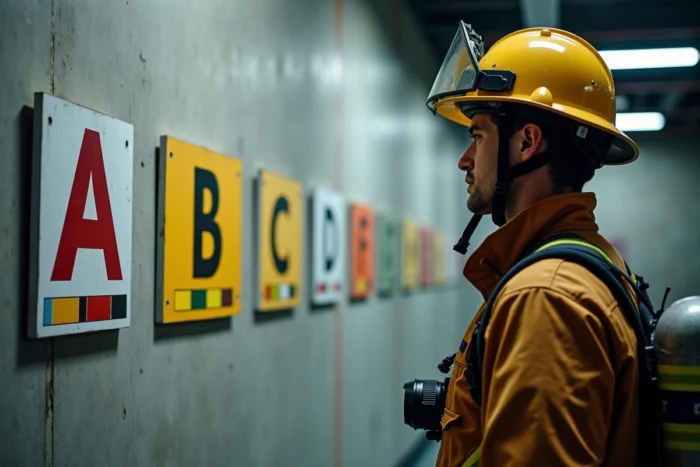
The classification of fires is based on the nature of the combustible material involved. This technical foundation, standardized in Europe, determines the choice of extinguishing agent and conditions the effectiveness of any intervention. In France, five classes (A, B, C, D, F) structure the prevention and training of both professionals and individuals. Understanding these fire classes remains a prerequisite to avoid extinguishing errors, some of which can worsen a disaster instead of containing it.
Confusion between fire classes and euroclasses of reaction to fire
A misunderstanding frequently arises in discussions between building professionals and safety managers. Fire classes (A to F) refer to the nature of the burning combustible. The euroclasses defined by standard EN 13501-1, on the other hand, evaluate the reaction to fire of construction products, with a classification ranging from A1 to F, supplemented by smoke indices (s1 to s3) and flaming droplets (d0 to d2).
A material classified as A2-s1,d0 according to this standard has no direct relation to a class A fire. The euroclasses measure a material’s behavior in the event of fire, not the type of fire. Mixing these two reference systems leads to specification errors in the specifications, particularly for establishments open to the public.
To delve deeper into fire classes and their specifics, it is essential first to establish this clear distinction between disaster classification and construction material classification.
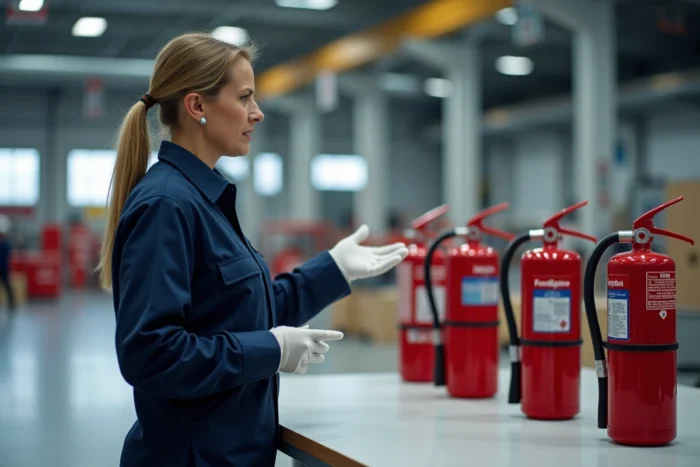
Class A and Class B: why the choice of extinguisher makes all the difference
Class A fires involve solid organic materials: wood, paper, cardboard, fabrics, certain plastics. Their particularity lies in the formation of glowing embers. Even after the visible flames have disappeared, the residual heat from the embers can reignite the fire if the area is not cooled thoroughly. Water, due to its cooling effect, remains the most suitable agent. Water mist extinguishers with additives or foam extinguishers also work.
Class B fires involve flammable liquids or liquefiable solids: gasoline, oils, solvents, certain waxes. Spraying water on a class B fire poses a risk of splashing burning liquid. Extinguishing requires smothering, using foam, powder, or CO2.
This difference between cooling (class A) and smothering (class B) is the first point addressed in any fire safety training. Using the wrong extinguishing agent can accelerate the spread instead of slowing it down.
Classes C, D, and F: three specific risks often underestimated
Fires involving flammable gases (class C)
Propane, butane, natural gas: class C fires involve burning gases. The basic rule is not to extinguish the flame until the gas source is cut off. Extinguishing without cutting off the supply allows gas to accumulate in the area, creating a risk of explosion far more serious than the initial fire.
Fires involving combustible metals (class D)
Magnesium, sodium, powdered aluminum, titanium: these metals burn at extreme temperatures. Water and CO2 are contraindicated on a metal fire, as they can cause violent reactions. Only specific extinguishing agents (special powders based on sodium carbonate or graphite) are suitable. This type of fire is primarily encountered in industrial settings and certain laboratories.
Fires involving cooking oils and fats (class F)
Class F concerns fires involving cooking oils and fats. These fires reach very high temperatures and exhibit particular behavior: water causes explosive vaporization that projects burning oil. Suitable extinguishers use a chemical solution that forms a waterproof film on the surface, cutting off the oxygen supply.
- In professional kitchens, regular maintenance of hoods and ventilation systems reduces the accumulation of fats, the main fire ignition factor
- Portable class F extinguishers must be installed in immediate proximity to cooking stations, not in a hallway or a distant technical room
- Training staff in the handling of these extinguishers is part of the regulatory obligations for food establishments
Electrical risk and class E: a case that divides reference systems
In Europe, there is no class E. A fire involving live electrical equipment is treated as a class A or B fire, with an added electrical risk. The Spanish fire protection regulation (RD 513/2017) explicitly reminds of this absence of class E in the standardized European classification.
In contrast, the Russian classification includes a specific class E for live electrical installations. This divergence between reference systems creates confusion among professionals who work internationally or consult sources from multiple countries.
The first reflex in the face of an electrical fire remains to cut off the power supply. Once the current is cut, the fire is addressed according to the nature of the combustible that is actually burning (solid, liquid). As long as voltage is present, CO2 extinguishers are preferred because they are non-conductive and leave no residue on equipment.
Choosing a suitable extinguisher: concrete selection criteria
The choice of an extinguisher is not based solely on the fire class. Several parameters come into play depending on the environment.
- The type of combustibles present in the area: a woodworking shop (class A) has different needs than a car garage where solvents are stored (class B)
- The presence of sensitive electrical equipment points towards CO2, which does not degrade electronic components, unlike powder
- The volume of the room and the available ventilation influence the effectiveness of the extinguishing agent: a CO2 extinguisher loses effectiveness in a highly ventilated space as the gas disperses before smothering the fire
- The user’s ability to handle the device: a large-capacity powder extinguisher is heavy and requires practical training to be used correctly
Periodic maintenance of extinguishers, mandated by regulation, ensures their functionality on the day they are needed. A device with insufficient pressure or expired agent will only provide illusory protection.
Identifying the fire class before acting, checking the suitability of the available extinguisher, cutting off energy sources when possible: these three reflexes condition the outcome of the first minutes of a fire outbreak, well before the arrival of professional help.