
A fulfilling family life is not just a checklist of good habits. The daily lives of French parents are undergoing profound changes, and some structural issues remain little addressed in usual resources.
Solo father-child time: what recent data says
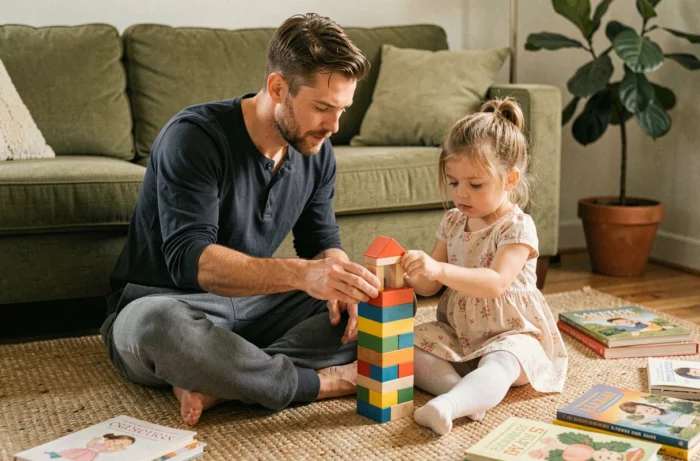
Between 2002 and 2021, the overall presence of fathers with young children increased by about 2.5 hours per week. This figure seems positive. However, the time spent alone with the child has decreased by about 30 minutes over the same period.
Another concerning indicator: 45% of children under 6 are never alone with their father during a typical week. In practice, fathers spend more time at home, but rarely in exclusive situations with the child.
One-on-one interactions (games, outings, meals) create distinct relational dynamics from those that occur when the other parent is present in the room. This gap between increased presence and decreased exclusive contact deserves consideration in organizing family daily life.
The resources available on cap-famille.fr address this issue from a practical angle, offering concrete suggestions for reorganizing parental daily life around these exclusive times.
Parental burnout: a documented phenomenon in France
About 6% of parents in France are said to be affected by parental burnout. This figure points to an identified public health issue, far from a mere diffuse feeling. There are resources available, such as the 1000 first days website, managed by Santé publique France, which offers validated advice for pregnancy and the early years of a child’s life.
Three markers distinguish parental burnout from ordinary stress: persistent physical and emotional exhaustion, emotional detachment from the children, and a feeling of inefficacy in the parenting role. The boundary with chronic fatigue remains blurry for many families, as symptoms overlap and gradually intensify.
Identifying signals before collapse
Parental burnout develops in stages, making it difficult to identify from within. Some warning signs recur in the literature:
- A feeling of fatigue that persists even after a period of rest (vacation, extended weekend), rather than a simple momentary tiredness.
- Disproportionate irritability in response to mundane family situations, such as a spilled meal or a child’s refusal to go to bed.
- Emotional disengagement, where the parent performs actions without feeling pleasure or connection with their children.
Consulting a healthcare professional as soon as these signals appear can prevent the situation from becoming chronic. The taboo surrounding difficult parenting still hinders many families in this process.
Budget pressure and couple life: a structuring factor
Family balance does not only play out on an emotional level. The fixed expenses of French households have significantly increased in recent years, reducing the margin for family activities, leisure, or outings. The budget conditions available time as much as energy.
For single-parent families, this pressure takes on a particular dimension. The cost of single parenthood affects the daily budget, but also the parent’s availability, often forced to juggle work and domestic management without support.
Prioritize rather than accumulate activities
Multiplying cultural outings, vacations, and educational games clashes with the financial reality of many households. Choosing two or three regular activities instead of chaining ten occasional ones creates a more lasting effect on family cohesion.
The available data do not allow for a conclusion on an ideal threshold for family spending. However, families that clearly identify their priorities (outdoor time, home games, shared reading) report a better experience than those trying to cover everything.
Education and children’s emotions: French institutional work
The CNAF has launched studies on the needs of parents in fulfilling their parental roles, aiming to better target the support offered by CAF. This approach is based on a factual observation: parents’ needs vary significantly depending on family structure (couple, single parent, blended family) and the age of the children.
A relevant piece of advice for a parent of an infant may be inappropriate for a family with teenagers. General guides often overlook these differences.
Tailoring advice to the actual family configuration
The reality of family daily life requires a targeted rather than universal approach:
- For families with young children, managing sleep and routines is the main lever for parental well-being.
- For blended families, clarifying the roles of each adult with the children reduces daily tensions.
- For parents of teenagers, maintaining short but regular rituals (a shared meal, a weekly activity) preserves the bond despite the move toward autonomy.
French data on parental burnout, father-child time, and budget pressure show that the barriers to a peaceful family life are often structural, not just relational. Identifying these barriers in one’s own configuration remains the first concrete step to reducing them.