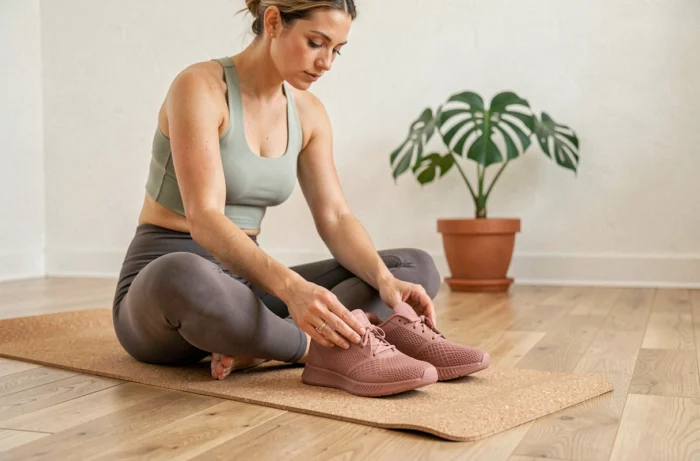
Between non-slip socks, minimalist shoes, and barefoot practice, the options for protecting your feet during a yoga session have multiplied. Not all of them meet the same requirements for stability, flexibility, and grip. This article compares the main categories of women’s yoga shoes based on the type of practice, the level of proprioception sought, and versatility outside the studio.
Thin sole, zero drop, toe box: the technical criteria that differentiate the models
Competing guides often list generic advantages (comfort, grip, aesthetics) without specifying what technically distinguishes one model from another. Three parameters allow for an objective comparison of women’s yoga shoes.
The first is the thickness of the sole. The thinner it is, the more pronounced the sensory feedback with the ground. So-called “barefoot” models offer an ultra-thin sole that replicates the feeling of being barefoot while protecting the sole from cold or rough surfaces.
The second criterion is the drop, which is the height difference between the heel and the front of the foot. A zero drop promotes a natural alignment of the pelvis and back, which is particularly important in balance postures and forward bends.
The third parameter is the width of the toe box. Sufficient space allows for the natural splaying of the toes, which plays a direct role in stability during standing postures. Models with a narrow toe box, inherited from traditional running shoes, limit this mobility.
To choose the right women’s yoga shoes, these three criteria matter more than design or brand.
| Criterion | Non-slip sock | Minimalist shoe (barefoot) | Light fitness sneaker |
|---|---|---|---|
| Sole thickness | None (fabric only) | Very thin | Medium to thick |
| Drop | Zero | Zero | Variable (often positive) |
| Toe box | Wide (models with separated toes) or standard | Wide | Standard to narrow |
| Grip on the ground | Good on mat | Good on all surfaces | Fair, but rigid sole |
| Proprioception | High | High | Reduced |
| Use outside the studio | No | Yes (city, commute) | Yes |
Yoga shoes and foot strengthening: what biomechanics research indicates
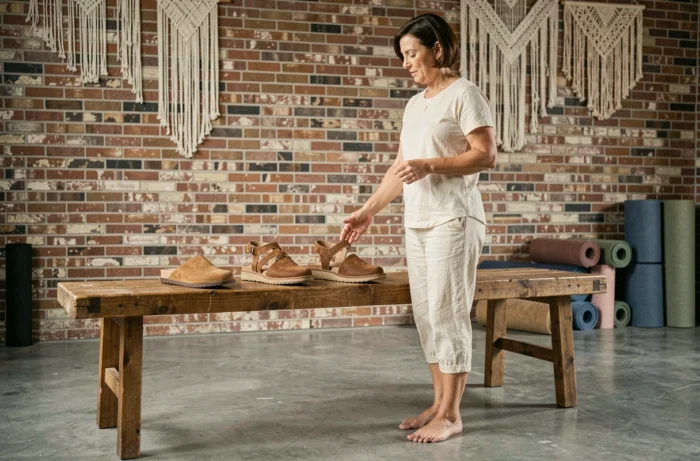
The barefoot trend is not solely based on a preference for comfort. Research in biomechanics has documented the link between walking or exercising in minimalist shoes and the strengthening of the intrinsic muscles of the foot, often referred to as the “foot core.”
These deep muscles, located under the arch, contribute to the dynamic stabilization of the foot. When they are engaged without the assistance of a thick sole, they gradually strengthen, improving balance and proprioception.
For yoga practitioners, this means that a shoe that is too structured (thick sole, marked arch support) can actually limit the postural benefits of the session. Conversely, a too abrupt transition to minimalism, without gradual adaptation, can cause pain in the Achilles tendon or the plantar fascia.
The most consistent recommendation is to alternate: barefoot on the studio mat, minimalist shoe for outdoor sessions or on hard surfaces, and gradually increasing the time spent without a thick sole.
Athleisure trend: women’s yoga shoes suitable for everyday wear
The women’s athleisure market has largely surpassed the confines of the studio. Market reports indicate that women represent the majority of athleisure demand, with a strong focus on yoga. The direct consequence on shoe choice: practitioners seek models that work well during a class as well as on the commute from home to studio or at the office.
Since 2024, several brands have launched hybrid models at the intersection of sporty ballet flats and minimalist slippers. The so-called “gymnarina” trend (sporty ballet flat with a thin, flexible sole) illustrates this convergence between performance and style. Models like the Adidas Taekwondo Mei, inspired by martial arts, are worn both in yoga classes and in the city.
- Minimalist slippers with a flat sole are suitable for gentle practices (hatha, yin) and can be easily worn outside thanks to a sleek design.
- Five-toed shoes (like Vibram FiveFingers) maximize proprioception and foot strengthening, but their aesthetics limit daily wear for some practitioners.
- Ultra-light sneakers with a zero drop offer the best compromise between versatility and style for hybrid yoga, barre, or pilates classes, with a look compatible with city wear.
This versatility criterion is rarely taken into account in classic comparisons, which focus on performance in the studio. For a regular practitioner, a shoe worn only during the session is a less profitable investment compared to a model usable for several hours a day.
Dynamic yoga, gentle yoga: adapting the shoe to the type of session
The choice cannot be the same for an Ashtanga class and a yin yoga session. The biomechanical constraints vary significantly.
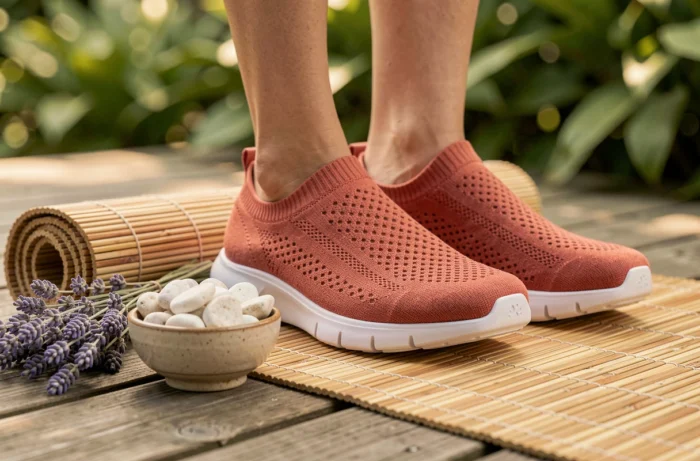
In dynamic yoga (Ashtanga, Power Yoga, Vinyasa), fast sequences and transitions on the ground require maximum grip and a sole that does not hinder position changes. Non-slip socks with silicone dots remain the lightest solution, provided the fabric is tight enough not to slip on the foot during quick movements.
In gentle or meditative yoga, the priority shifts to thermal comfort and the feeling of cocooning. A closed minimalist shoe protects from the cold without compromising proprioception. Practitioners who have cold feet in winter often abandon being barefoot, making the minimalist shoe particularly relevant in this context.
For outdoor sessions (park, terrace, beach), a thin but durable sole resistant to small debris is the main criterion. Barefoot models with a natural rubber sole meet this need without adding rigidity.
The type of session determines the level of protection needed. Starting from your actual practice, rather than a marketing category, remains the most reliable method for identifying the right women’s yoga shoe.