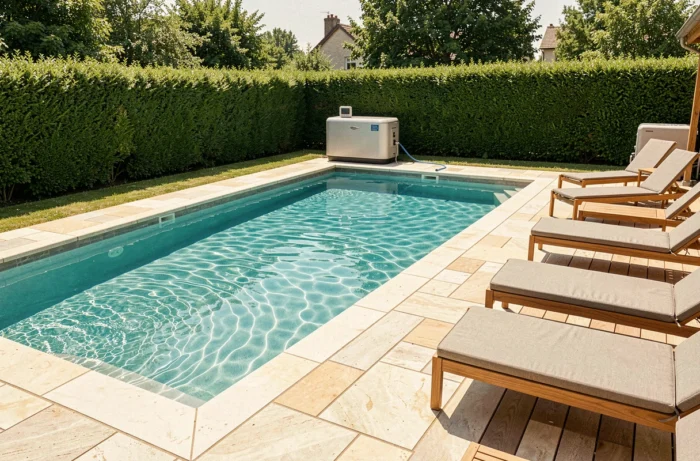
A saltwater pool produces its own chlorine thanks to the electrolyzer, but this operation does not protect it from turning green. Chlorine production depends on parameters that the automatic system does not correct on its own: water temperature, pH, condition of the cell, and filtration duration.
When one of these factors goes awry, algae can establish themselves in just a few hours. The five points that follow target the real causes of green water in a saltwater pool, not the generalities applicable to any pool.
1. Check the pH twice a week during hot periods
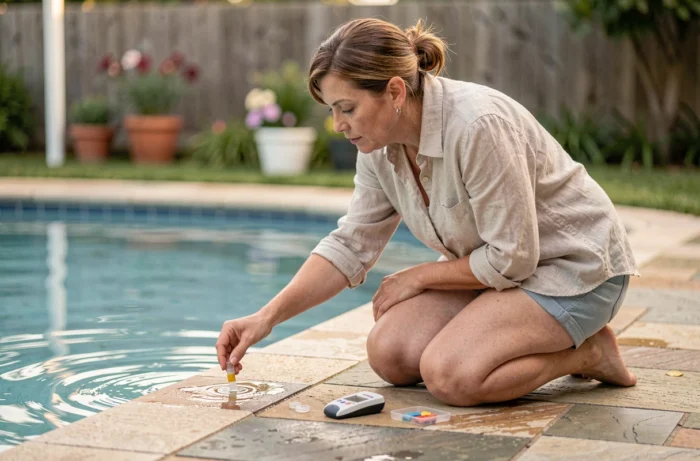
The electrolysis of salt has a peculiarity that many owners discover too late: it naturally raises the pH. The chemical reaction that transforms salt into chlorine also releases soda, which continuously pushes the pH upward.
A pH above 7.4 significantly reduces the effectiveness of the chlorine produced by the cell. The electrolyzer works, the salt level is correct, but the active chlorine in the pool becomes insufficient to prevent algae proliferation. This is the most common cause of green water in a saltwater pool.
Owners looking for solutions against green water in saltwater pools often find that the problem simply stemmed from an uncorrected pH for several days. Testing twice a week between May and September, with a pH-Minus corrector on hand, is enough to maintain the pH range between 7.0 and 7.4 where chlorine remains fully active.
2. Adjust the filtration time to the water temperature
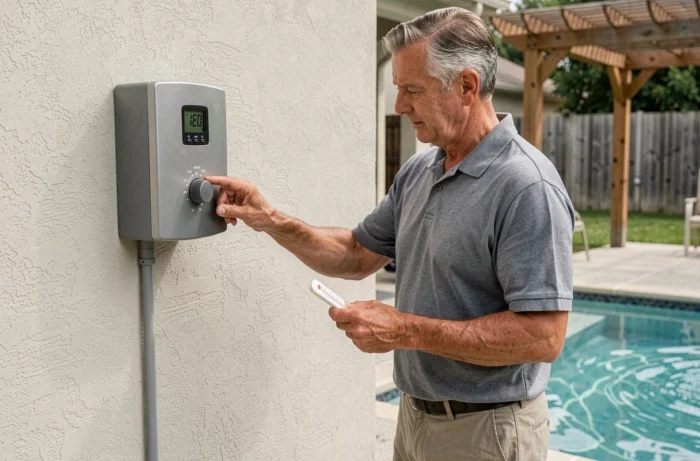
The classic rule is to divide the water temperature by two to get the number of daily filtration hours. In a saltwater pool, this rule becomes a minimum, not a target.
The electrolyzer only produces chlorine when the pump is running. Therefore, reducing filtration means reducing the production of disinfectant exactly when warm water encourages algae growth. When the water exceeds 28 °C, field reports show that it is often necessary to filter more than the temperature/half ratio.
Filtering during the hottest hours of the day increases chlorine production during the peak of algal development. Scheduling filtration from 10 AM to 8 PM instead of at night radically changes the effectiveness of the treatment, without altering overall electricity consumption.
3. Inspect and descale the electrolyzer cell
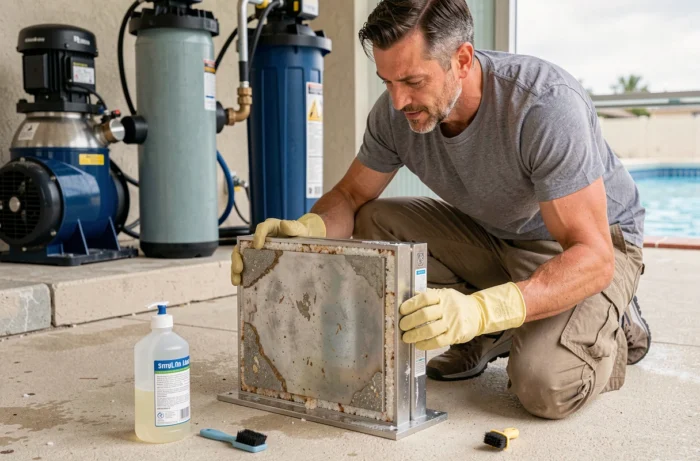
A scaled cell produces less chlorine. Limescale deposits on the titanium plates and gradually reduces efficiency, sometimes by half, without triggering an alert on entry-level models.
Most recent electrolyzers include a polarity inversion function that limits scaling. This function does not eliminate the problem. A visual check every two to three months remains necessary. If white deposits cover the plates, soaking them in a mild acid solution (white vinegar or diluted hydrochloric acid) for a few minutes is enough to restore efficiency.
- Turn off the power to the electrolyzer before any manipulation of the cell
- Check that the connectors are not corroded, a sign of a cell nearing the end of its life
- On models without polarity inversion, descaling should be monthly during the season
4. Maintain a stable salt level in the pool
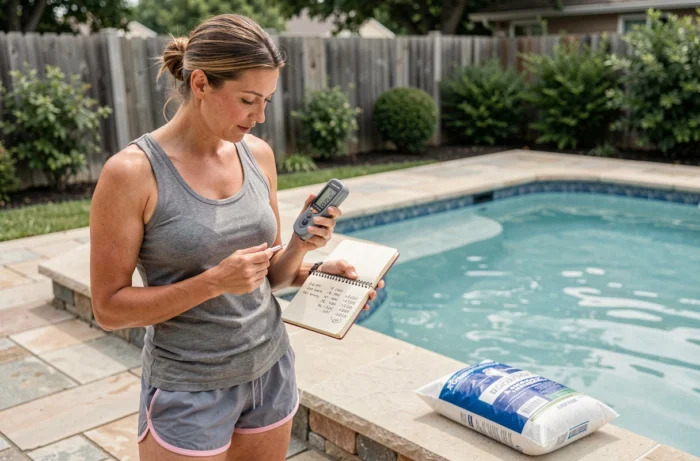
The salt level decreases over the season: splashes, filter washes, diluting rains. When the concentration drops below the threshold required by the device (generally around 3 to 5 g/L depending on the classic models), the electrolyzer reduces or stops its chlorine production.
Some devices display a “low salt” alert, others do not. Measuring the salt level at least once a month with a dedicated tester avoids unpleasant surprises. A simple addition of pool salt, spread in front of the return jets while filtration is running, corrects the deficit in a few hours.
Next-generation electrolyzers with inverter technology operate with lower concentrations, around 1 to 1.2 g/L. This reduced salinity decreases discharge constraints and corrosion, but requires even more rigorous monitoring: the margin of error on concentration becomes very narrow.
5. Brush the walls and bottom before the biofilm establishes
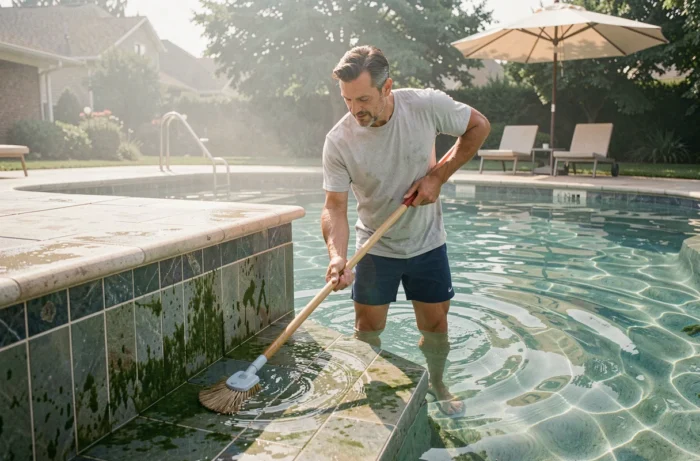
The chlorine produced by the electrolyzer acts in the free water. Algae that begin to attach to the liner, concrete, or tile joints form a protective biofilm that the dissolved disinfectant does not penetrate easily.
Weekly brushing of the walls, waterline, and less circulated areas (stairs, corners, behind the ladder) dislodges these micro-colonies before they become visible. The pool robot cleans the bottom, but it does not replace brushing the vertical walls and corners.
- Brush before starting filtration so that the dislodged particles are sucked in by the skimmer
- Focus on the shaded areas of the pool, where the surface temperature remains warm and the water circulates less
- A biofilm established for several days requires a shock treatment in addition to brushing, which could have been avoided with regular brushing
Managing a saltwater pool relies on a balance between chlorine production, water circulation, and chemical parameters. None of these five points is complex in itself, but it is their regular combination that makes the difference. A pH that drifts during a week of heatwave is enough to turn a clear pool into opaque water, even with a recent electrolyzer and a correct salt level.