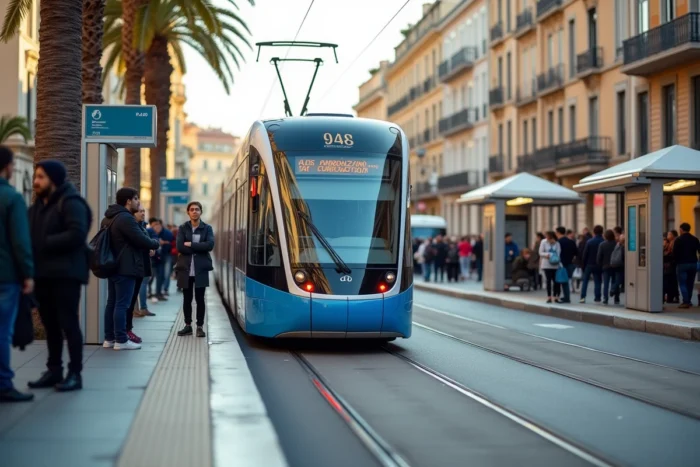
The Lignes d’Azur network structures mobility in Nice, but its recent fare changes are reshaping urban accessibility. The free transport for children, effective for a year, and the one announced for seniors and certain public agents starting September 1, 2026, profoundly alter residents’ relationship with the metropolis’ infrastructure.
Free Transport in Nice: An Underestimated Lever for Urban Accessibility
The Métropole Nice Côte d’Azur has confirmed the free access to the Lignes d’Azur network starting September 1, 2026 for residents aged 65 and over, with no income conditions. Staff from the CHU de Nice and agents from the prison center are also included. This measure targets populations whose mobility directly affects access to healthcare, administrative services, and social connections.
We observe that this type of targeted free access produces tangible effects on modal shift. Seniors who previously avoided trips to the city center due to a lack of affordable parking now have a frictionless alternative. For hospital staff, who work irregular hours, the elimination of subscription costs alleviates a recurring constraint.
Some see why Nice is a poorly managed city in terms of urban management, pointing out that the bus network is still insufficient during off-peak hours in peripheral neighborhoods. Free access does not resolve frequency or connectivity, two structural weaknesses of the network outside the hypercenter.
Free Child Subscription in Nice: The Trap of 15 Euros Management Fees
The “pitchoui” subscription offers free public transport for Nice’s children on the Lignes d’Azur network. On paper, the advantage is clear for families. In practice, 15 euros in management fees are charged each year per child.
This amount seems modest, but it constitutes an administrative barrier that penalizes large families or those in precarious situations. Three children represent 45 euros annually for a supposedly free service. The annual renewal also requires a visit to the counter or online, with the processing times that entails.
This model illustrates a common flaw in municipal free access policies: the political announcement masks a residual cost and an administrative burden that the most vulnerable users struggle to absorb. We recommend families check renewal conditions several weeks before the deadline to avoid a lapse in transport coverage.
Digital Public Services in Nice: The One-Stop Shop Facing Usage Gaps
The city of Nice has launched the “Nice Facile” initiative, a one-stop shop that centralizes administrative procedures. The stated goal is to simplify access to municipal services, from after-school care to civil status.
Digital centralization favors users who are already connected and penalizes those who are distanced from digital technology. Unequipped seniors, people with disabilities who require physical assistance, and residents of the northern neighborhoods, which are less well-served by municipal branches, find themselves in a blind spot of the system.
Nice has also structured an accessibility policy for people with disabilities, with commitments to adapt public spaces and transport. The reality on the ground remains mixed:
- Tram lines are accessible to wheelchairs, but some bus stations still lack raised platforms
- The nice.fr website offers content in “easy to read and understand” (FALC), which remains rare for a municipality of this size
- Processing times for disability-related requests (parking permits, specific aids) vary greatly depending on the branches
Car-Free Mobility in Nice: Real Alternatives and Grey Areas
Nice has a tram network that has expanded in recent years, complemented by bus lines, Uber services, and soft mobility initiatives. For a resident of the center or neighborhoods close to the coast, getting around without a car in Nice is technically viable on a daily basis.
The situation changes as one moves away from the main thoroughfares. The Nice hills and higher residential neighborhoods (Cimiez, Gairaut, Saint-Roman-de-Bellet) remain dependent on infrequent bus lines. The last evening service occurs early, forcing residents to rely on personal vehicles or ride-hailing services.

The municipal sustainable mobility policy includes the “Prise de Nice” initiative for the deployment of electric charging stations, but the pace of installation remains below demand in the older condominiums of the city center. Haussmannian or Belle Époque buildings, predominant in some neighborhoods, pose significant technical constraints for cable installation and the setup of charging stations in underground parking.
Nice Real Estate Market and Pressure on Local Services
The continuous influx of new residents, combined with tourist attractiveness, exerts direct pressure on local services. Medical practices in the center report increasing wait times. The CHU de Nice concentrates a disproportionate share of hospital demand due to insufficient intermediate structures in peripheral neighborhoods.
The real estate market amplifies this imbalance. High apartment prices push young professionals to neighboring municipalities (Saint-Laurent-du-Var, Cagnes-sur-Mer), but they continue to use Nice’s infrastructure for work, leisure, and healthcare. The metropolis thus supports a user population far exceeding its declared resident population.
- Schools in central neighborhoods face demographic pressure that new class openings do not always compensate for
- Green spaces, often cited as an asset of Nice’s quality of life, see increased usage without proportional maintenance budgets
- The short-term rental market reduces the available supply for permanent residents, fueling market tension
The assessment of Nice’s infrastructure is not limited to a positive or negative balance. Recent investments in mobility and the digitization of services reflect a desire for modernization. Blind spots persist regarding transport connectivity in the periphery, real access to services for vulnerable populations, and the capacity of collective facilities to absorb sustained population growth.