The choice of equipment for the baby’s room revolves around three technical axes that most guides overlook: the thermal regulation of the room, the indoor air quality related to materials, and the actual compliance of the bedding with current French health recommendations. We address these points from the perspective of product specifications, not decoration.
Thermal regulation and heating in the baby’s room
The temperature of the room determines the type of mattress, the choice of textiles, and the heating system. Recommendations place the ideal range between 18 and 20 °C, with a humidity level between 40 and 60%. Below 40%, the infant’s nasal mucous membranes dry out, disrupting sleep and promoting ENT infections.
On the heating side, inertia radiators provide the most stable heat for a child’s room. Their temperature rise is gradual, without jolts, and thermal release continues after they are turned off. Conventional fan heaters and convectors dry out the air and create sharp variations, two parameters incompatible with an infant’s comfort.
A thermometer-hygrometer placed at the height of the crib allows for continuous monitoring of these two values. Parents who want to go further can install a cool mist humidifier (without essential oils or fragrance) to correct excessively dry air, which is common in winter with central heating.
We also recommend assessing the window coverings: a thermal-lined blackout blind or curtain limits heat loss at night and protects against summer overheating. For those who wish to learn more about Niddou.com, the site details the selection criteria by equipment category.
Air quality and material choices for baby equipment
Every new textile must be washed before first use. The Ministry of Health explicitly reminds us: sheets, sleeping bags, play mats, stuffed animals, clothing. This precaution reduces the concentration of chemical residues from manufacturing and transport.
Beyond washing, the choice of furniture materials is as important as that of textiles. Standard particle board furniture releases formaldehyde for several weeks after unpacking. We observe that baby product manufacturers now offer panels classified E0.5 or E1, but the performance gap between the two remains significant regarding air quality measured at crib height.
- Wall paint: prefer a finish applied several weeks before the baby’s arrival, with low VOC content
- Solid wood furniture that is untreated or certified E0.5: limits formaldehyde emissions in the room
- Textiles labeled Oeko-Tex Standard 100 class 1 (the class dedicated to baby items): guarantees the absence of harmful substances beyond regulatory thresholds
- Systematically avoid sprays, air fresheners, and candles in the infant’s room
The room should be aired daily, even in winter, for about ten minutes. This simple gesture remains the most effective way to renew the air and lower indoor pollutant concentration.
Baby bed and mattress: what safety standards really require
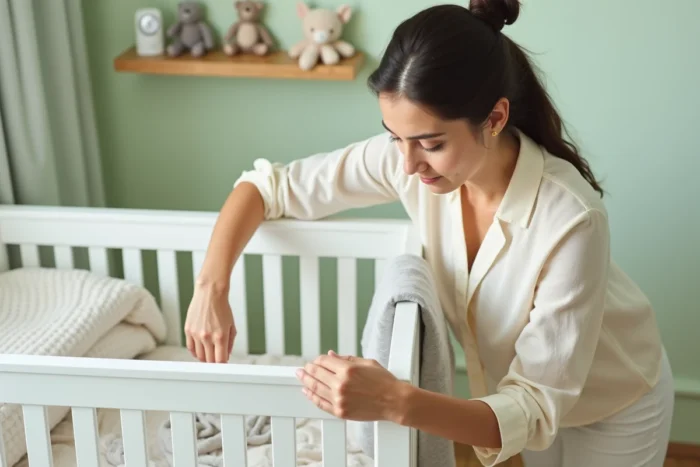
A crib without any unnecessary accessories remains the safest configuration. French health authorities are clear: no bumper pads, no pillows, no loose blankets, no baby wedges, no stuffed animals in the crib during sleep. Baby sleeps on their back, in a suitable sleeping bag for their size, on a firm mattress covered with a well-fitted fitted sheet.
The mattress deserves special attention. Its firmness is not judged by touch in the store but by the depth of indentation under the weight of the infant. A mattress that is too soft increases the risk of suffocation if the baby turns face down onto the bedding. The mattress density must be sufficient so that a child weighing a few kilos does not create a noticeable dip.
Regarding dimensions, the mattress must fit exactly in the crib frame, with no residual space between the edge of the mattress and the bars. A gap of a few centimeters is enough for an arm or leg to get stuck. We recommend measuring the inside of the crib before purchase rather than relying on the standard dimensions advertised by the manufacturer.
Changing table and storage: ergonomics of the changing area
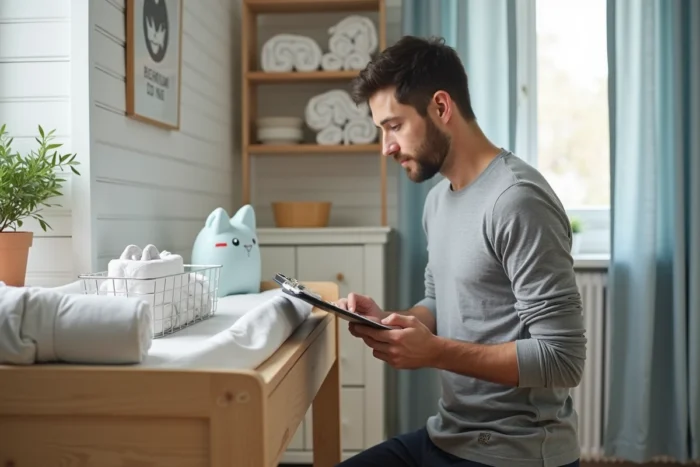
The changing area is the second functional pole of the room, after the sleeping area. The height of the changing surface should allow parents to stand without bending over. An incorrect height can cause back pain within the first few weeks, a period when the frequency of changes far exceeds ten daily.
- A changing mat with raised edges on the sides limits the risk of lateral falls during changing
- Integrated storage (open shelves or drawers) under the changing surface allows for easy access to diapers, lotion, and spare clothes with one hand
- A combined changing dresser replaces two pieces of furniture with one, freeing up floor space in small rooms
Never take your eyes off a baby placed on the changing table, even for a moment. This is the leading cause of domestic falls among infants. The phone, spare diapers, lotion: everything must be within reach before placing the child down.
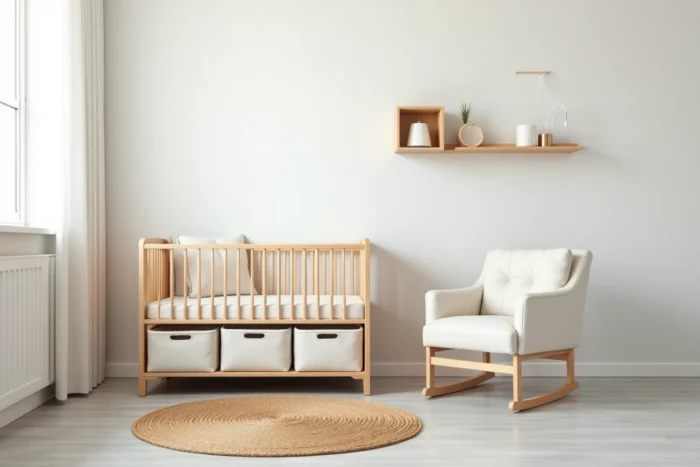
The flooring also plays a role in the overall safety of the room. A hard floor (wood, tile) combined with a washable rug offers a good compromise between hygiene and thermal comfort on the floor during awake phases. Thick carpets accumulate more dust mites and dust, which returns to the air quality issue mentioned above.
The equipment in a baby’s room benefits from remaining simple. Every added item in the room is a potential source of dust, chemical compounds, or mechanical risk. A compliant crib, a firm mattress, an ergonomic changing area, stable heating, and washed textiles: these five elements cover the real needs of the infant without cluttering the space.