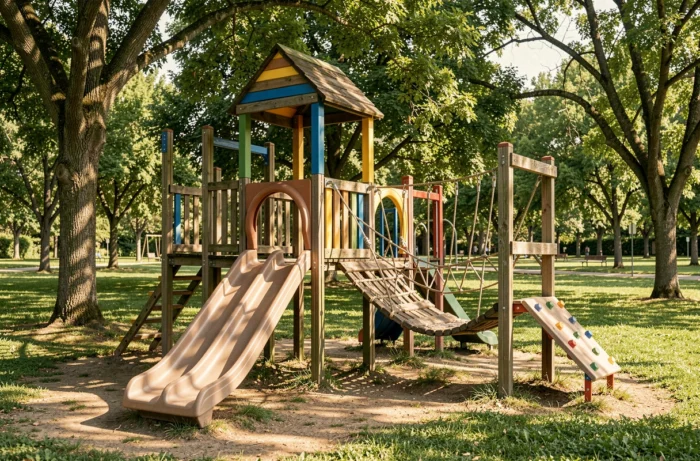
Choosing a play structure for a children’s playground involves balancing the available space, the target age groups, and regulatory constraints. The differences between the main categories of equipment (multiplay, climbing structures, water games, sensory trails) relate to installation costs, lifespan, and play potential. This article compares these categories based on measurable criteria to identify the most relevant configurations according to the context of installation.
Comparison of Main Play Structures for Playgrounds
Play structures are divided into major families, each suited for different uses and spaces. The table below summarizes their operational characteristics.
| Type of Structure | Age Range | Footprint | Dominant Material | Covered Activities |
|---|---|---|---|---|
| Multiplay (tower + slide + bridge) | 3-12 years | Large | Wood or steel + HDPE | Climbing, sliding, hiding |
| Swings / swing set | 2-14 years | Medium | Galvanized steel or wood | Swinging, coordination |
| Balance course (nets, beams) | 4-12 years | Variable (linear) | Rope, steel, wood | Motor skills, risk-taking |
| Water games / playful fountains | 1-10 years | Medium to large | Stainless steel, resin | Sensory play, cooling off |
| Sandpit / manipulation games | 1-6 years | Compact | Wood, HDPE | Manipulation, free play |
| Pumptrack (bumpy circuit) | 6-14 years | Large | Concrete, asphalt | Biking, scootering, rollerblading |
A specialized manufacturer or supplier can offer custom configurations combining several of these families. Complete catalogs are available at https://www.joker-amusement.com/, covering modular structures as well as themed equipment.
The choice between these categories rarely depends on a single criterion. The footprint directly determines the type of structure that can be considered, but the regulations regarding safety zones around each piece of equipment also significantly influence the final sizing.
Playground Safety Standards: What Changes with EN 1176 and the GPSR Regulation
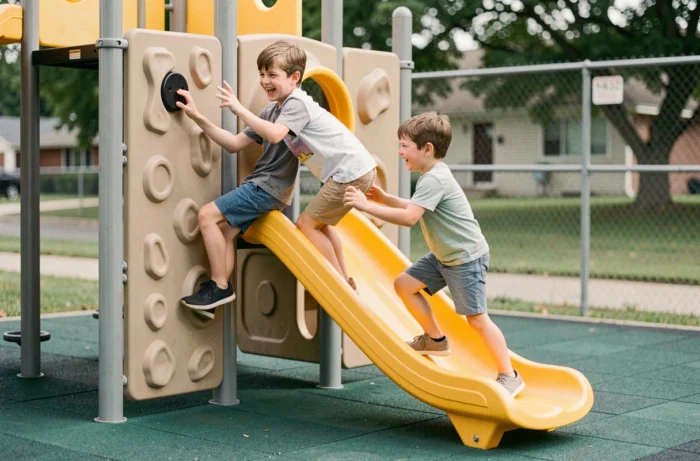
Every children’s playground installed in France must comply with the European standard EN 1176, which covers the design, installation, inspection, and maintenance of equipment. The EN 1176-10:2024 part specifically targets indoor play parks of the soft play or ball pit type, in addition to part 7 on maintenance.
This distinction is often underestimated by operators of indoor spaces. The requirements for fall height, spacing between elements, and the quality of shock-absorbing surfaces differ significantly between an outdoor park and a covered structure.
The GPSR Regulation 2023/988 and Its Practical Consequences
The Regulation (EU) 2023/988 on the general safety of products, applicable since December 13, 2024, strengthens traceability and withdrawal obligations for hazardous products for all recreational equipment. Operators of parks, such as local authorities, must now document more rigorously the origin and compliance of each installed module.
This text also applies to online purchases of structures, modules, and shock-absorbing surfaces. However, it does not change the design standards themselves: it affects post-marketing monitoring and the responsibility of distributors.
- Enhanced information obligation on the compliance of each component (manufacturer, importer, distributor)
- Documentary traceability required for each piece of equipment installed in a public space
- Accelerated withdrawal procedure in case of a reported safety defect on a product
Play Structures in Wood, Steel, or HDPE: Which Material for Which Use
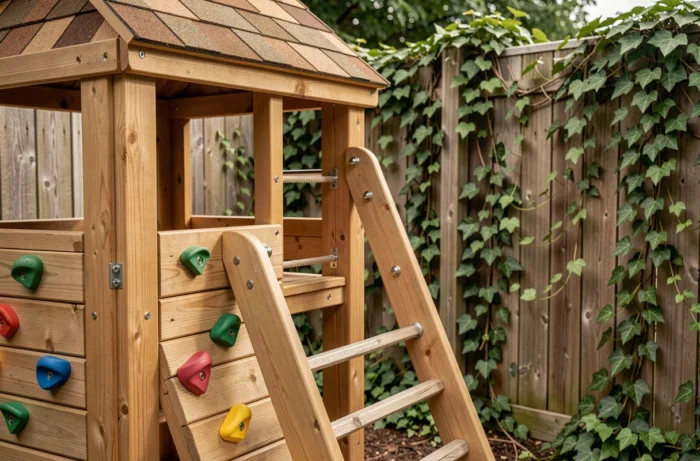
The dominant material of a play structure determines its durability, maintenance, and landscape integration. Wood remains the preferred choice for natural spaces and community parks, thanks to its aesthetics and ability to blend into a garden or green space.
Galvanized steel offers superior mechanical resistance and a longer lifespan without regular treatment. It is better suited for tall structures or equipment subjected to intensive use (urban parks, schoolyards).
Recycled HDPE, a Compromise Between Robustness and Environmental Commitment
Panels and flooring made from recycled HDPE (high-density polyethylene) are becoming common in modular structures. This material is resistant to UV, moisture, and shocks, while being 100% recyclable at the end of its life. Its touch is softer than steel, reducing the risk of injury from contact.
In contrast, HDPE limits the possibilities for curved shapes or sculpted details that wood allows. For a themed space (castle, boat, enchanted forest), wood or composite remains more suitable for customization.
Accessibility and Free Play: Two Trends Redefining Playgrounds
Recent documents aimed at local authorities detail concrete accessibility criteria: pathways suitable for wheelchairs, transfer-height games, sensory panels incorporating textures and sounds. Accessibility is no longer limited to a ramp but permeates the overall design of the area.
Sensory comfort is also making its way into specifications. Quiet zones, non-aggressive colors, and materials with varied textures allow children with sensory disorders to enjoy the space without overstimulation.
Adventure Grounds and Free Play in France
Imported from Nordic countries and the UK, the concept of adventure grounds is being tested in several French cities during the holidays. These spaces allow children to build, dismantle, and reassemble elements (boards, tires, ropes) under the supervision of facilitators.
Feedback is positive regarding autonomy, cooperation, and conflict regulation among children. This model does not replace a standardized playground but complements the offering by providing a managed risk relationship that traditional structures do not allow.
The choice of a play structure for a recreational area is based on a technical arbitration between available space, materials, and regulatory compliance. With the entry into force of the GPSR regulation and updates to the EN 1176 standard, the documentation of each piece of equipment weighs as heavily as the choice of slide or swing.
Local authorities and operators who integrate accessibility and free play from the design stage respond to a concrete demand from families.