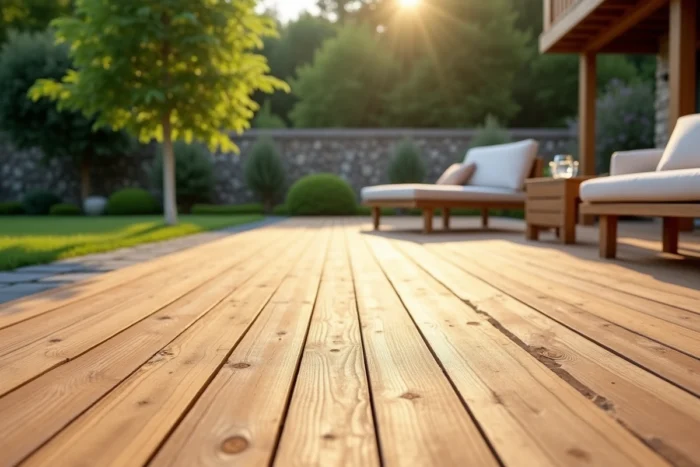
A south-facing terrace on poorly drained soil does not age at all like a raised terrace in the shade of a wall. Before comparing wood species, one must look at the specific situation of the installation: height relative to the ground, proximity to a pool, exposure to the elements. It is this site constraint that determines the suitable wood, not the other way around.
Thermally modified or acetylated wood: an underestimated option for a durable terrace
There is a lot of talk about pressure-treated softwoods, exotic woods like ipe or cumaru, and composites. However, modified woods (thermo-treated or acetylated) remain underrepresented in comparisons, even though they address a real site issue.
The principle is simple: wood is heated to high temperatures (for thermo-treatment) or its cellular structure is chemically modified (for acetylation). The result is a significantly improved dimensional stability and increased resistance to wood-destroying fungi, without resorting to pressure treatment products or imported tropical species.
Recent technical guides now classify modified woods among the major families to consider for a terrace, alongside softwoods, exotics, and composites. Thermo-treated ash, for example, achieves a sufficient use class for horizontal outdoor use, with a grain reminiscent of light exotic woods. Choosing the best wood for a terrace also involves this family of products, especially when one wants to limit maintenance without sacrificing aesthetics.
Feedback varies on this point depending on installation conditions, but acetylated wood shows a lifespan comparable to that of certain exotic woods in well-ventilated installations.
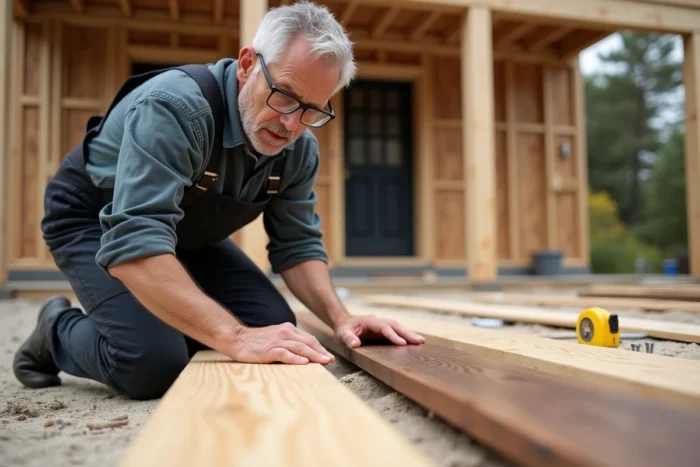
Ground-level terrace or raised terrace: the choice of species depends on the installation
This is the first question to ask, and most guides address it too quickly. A ground-level terrace, with joists close to the earth, creates a confined environment where moisture stagnates. In this case, a class 4 wood is technically mandatory for both the structure and the boards.
The joists are the most vulnerable part. They remain invisible, trapped between the ground and the decking, constantly exposed to soil evaporation. If pressure-treated class 3 pine is used for the joists of a ground-level terrace, degradation begins within a few seasons.
Raised terrace on pedestals: more flexibility on the species
A terrace on adjustable pedestals, ventilated from below, tolerates class 3 species for the boards. Air circulation limits fungal development. One can then consider larch, Douglas fir, or pressure-treated softwoods without taking a major risk.
For the supporting structure (joists, beams), one should stick to class 4 in all cases. Never downgrade the class for the structure, even in a raised terrace.
Pressure-treated pine, ipe, composite: decide based on actual use
Rather than creating a linear ranking, here are the three most common site scenarios and the species that best adapts to them.
- Tight budget, ground-level terrace in temperate zone: pressure-treated class 4 Scots pine remains the most accessible choice. It requires regular maintenance (brightener, saturator) and its lifespan directly depends on the quality of the treatment and initial drying. Ensure that the wood has been properly dried before treatment, not just impregnated through and through.
- Pool terrace or high exposure to water: ipe and cumaru offer a density and natural resistance to insects and fungi that make them suitable for prolonged contact with water. Their high weight complicates installation, and their price remains significantly higher than that of softwoods. Check for certification (FSC, PEFC) to ensure the source.
- Low maintenance desired, aesthetics secondary: composite (a mix of wood fibers and polymer) does not gray, does not crack, and requires only periodic cleaning. The trade-off is a less natural feel underfoot and a marked temperature rise in direct sunlight.
The trap of price per square meter
Comparing only the price of the boards skews the calculation. A pressure-treated pine board costs significantly less to purchase than an ipe board, but the annual maintenance (saturator, cleaning) and more frequent replacement of degraded boards alter the overall cost over ten or fifteen years.
Thinking in terms of total cost over the expected lifespan provides a more honest picture. A dense exotic wood or a high-quality composite, more expensive to install, can end up costing the same as a softwood maintained every year.
Site maintenance: what really makes a difference over time
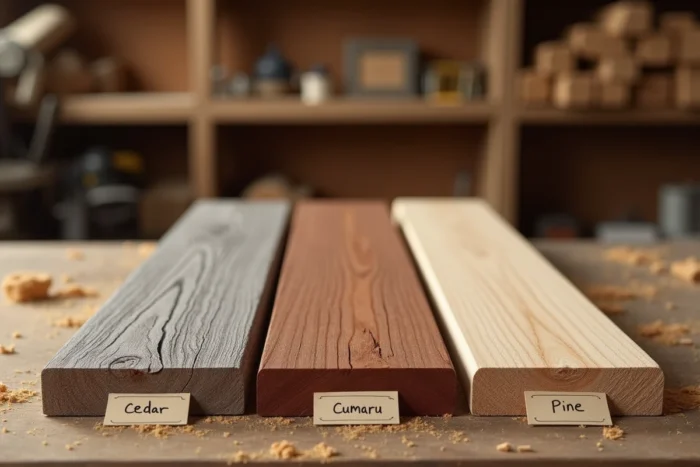
Graying affects all species exposed to UV rays. It is not a structural defect; it is a surface oxidation. Some homeowners accept it (the silver-gray of aged larch has its fans), while others want to maintain the original color.
To maintain the color, a saturator is applied once or twice a year depending on exposure. The brightener is used when the surface has already turned. These two products do not protect the wood deeply; they act on appearance.
What truly protects the terrace over time is ventilation under the decking, soil drainage, and the correct spacing between the boards to avoid water stagnation. A medium-quality wood well installed lasts longer than a high-end wood poorly ventilated.
Before choosing a species, one should therefore check that the support (pedestals, joists, drainage slope) is sized for the site configuration. The wood comes after.