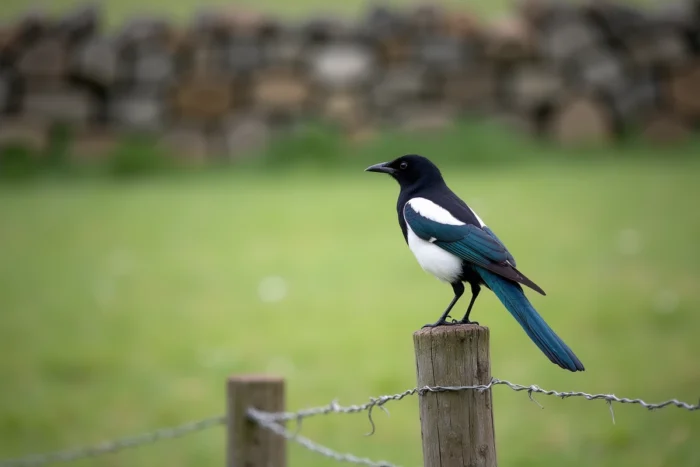
The Eurasian magpie (Pica pica) has a vocal repertoire that is much more structured than its reputation as a mere “chatterbox” suggests. Its vocalizations serve specific functions for social coordination, alerting, and territorial defense, and their analysis sheds light on both the biology of corvids and the persistence of the myth of the thieving magpie.
Vocal repertoire of the Eurasian magpie: alarm calls and mobbing
The vocalizations of Pica pica are not limited to the familiar chattering. We observe at least three distinct functional categories in the species’ sound register.
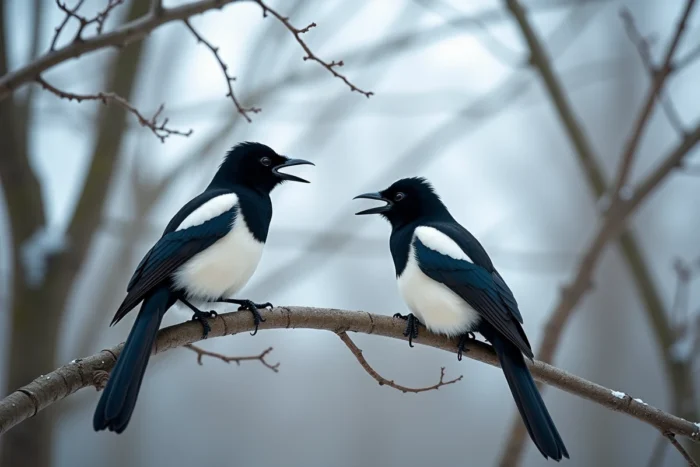
The alarm call, a series of shrill and rapid notes, is triggered in the presence of a terrestrial predator (cat, mustelid) or a human perceived as threatening. This signal does not simply provoke flight: it mobilizes conspecifics for a collective harassment called mobbing. Several magpies then converge on the source of danger, diving and calling in unison to drive away a raptor or a feline.
The structure of the call varies depending on the nature of the threat. In the face of an aerial predator (sparrowhawk, buzzard), the call is shorter and sharper than when facing a ground cat. This differentiation suggests that magpies convey qualitative information about the danger, not just a binary “alert / no alert” signal.
Other corvids like jays exhibit similar capabilities, but in the case of the magpie, coordinated mobbing regularly involves birds of neighboring species (blackbirds, tits) that also respond to its calls.
To delve deeper into the magpie’s call and its meaning, one must also consider the territorial song, which is more melodic and emitted at a low volume, produced by pairs in spring to delineate their nesting area.
Corvid intelligence and vocalizations: what the magpie’s cognition reveals
The Eurasian magpie belongs to the Corvidae family, a group whose cognitive abilities rival those of primates. This intelligence is directly manifested in the complexity of its vocal communications.
The magpie is one of the few birds to pass the mirror test, demonstrating a form of self-awareness. This cognitive ability is reflected in its social interactions: magpies adapt their vocalizations according to the interlocutor and the context, modulating intensity, rhythm, and frequency.
Recent work in animal cognition shows that some corvid species produce vocal sequences whose structure resembles combinatorial rules. In the magpie, the variety of its sound emissions (social chattering, modulated alarm call, territorial song, contact calls between partners) argues for a richer communication system than that of most passerines.
Social functions of chattering
The constant “chattering” that annoys so many residents serves a cohesion function. Magpies live in territorial pairs but form hierarchical groups outside the breeding season. Continuous chattering helps maintain contact between individuals, signal the discovery of food, and strengthen social bonds.
This is not random noise. Each vocal sequence corresponds to an identifiable social context: approach of a conspecific, food competition, courtship display. Reducing these vocalizations to mere “chattering” ignores the sophistication of the system.
Thieving magpie: what science really says about the attraction to shiny objects
The reputation of being a thief has preceded the magpie for centuries. Rossini’s opera La Gazza Ladra (1817), followed by Hergé’s album The Castafiore Emerald, has cemented this image in popular culture. Scientific reality sharply contradicts it.
Researchers from the University of Exeter conducted controlled experiments by presenting wild magpies with shiny objects (screws, small aluminum rectangles) alongside identical but dull objects. The result: the magpies showed no preference for shiny objects. They even generally avoided them, exhibiting neophobia, which is a distrust of unfamiliar objects.
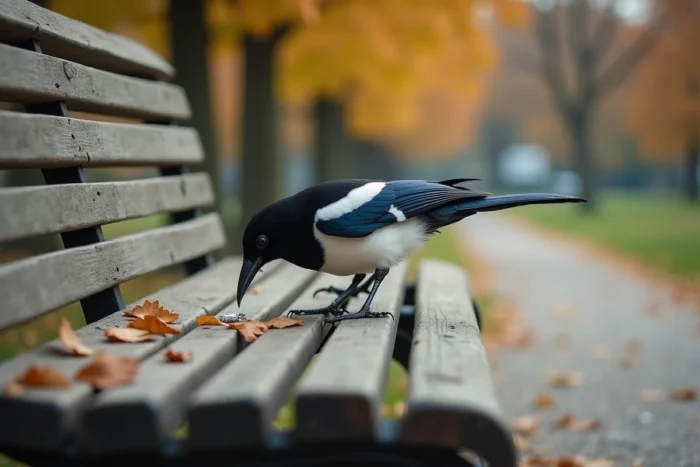
This study has put an end to a persistent myth. The magpie’s natural curiosity, linked to its intelligence, may lead it to examine an unusual object. However, nothing in its behavior resembles the deliberate “theft” of shiny objects to accumulate them in its nest.
Why the myth persists despite the data
Several factors explain the persistence of this reputation:
- The proximity of the magpie to inhabited areas makes it very visible, multiplying opportunities for biased observation (an object disappears, a magpie was in the garden, the cognitive shortcut sets in).
- European mythology and folklore have associated corvids with theft and deception since antiquity, long before any rigorous observation.
- The administrative classification of the magpie among “species likely to cause damage” (a term that replaced “pest” in 2016) reinforces the idea that it is a problematic bird, even though the reasons for this classification concern predation on the nests of other birds, not the theft of objects.
Ecological role of the Eurasian magpie and its place in the ecosystem
Rehabilitating the magpie also involves recalling its ecological function. As an opportunistic predator, it consumes a wide variety of invertebrates, small rodents, and carrion. This cleaning role contributes to the sanitary balance of peri-urban environments.
Its predation on the nests of other birds, often criticized, fits into a natural regulatory dynamic. Population studies show that the presence of magpies does not lead to a measurable decline in passerine species in areas where they coexist. The real causes of decline (land artificialization, pesticides, feline predation) weigh much more heavily.
The Eurasian magpie remains a useful indicator of urban biodiversity. Its adaptability to anthropized environments makes it a prime subject for studying how birds modify their vocalizations in noisy environments, an active research field in urban ecology.
Rather than perpetuating a reputation built on folklore and observational biases, we would benefit from listening to the magpie’s calls for what they are: a sophisticated communication system, reflecting one of the highest intelligences in the avian world.