
Disconnecting a battery on a recent vehicle is no longer just about removing two terminals. The Battery Management System (BMS) records the state of charge, aging profile, and residual capacity of the old battery. Installing a new element without resetting this module means allowing the system to manage the charge based on outdated parameters, which degrades the new battery within a few months.
Resetting BMS and battery registration: the procedure that consumer guides overlook
On Audi, BMW, Jaguar, Land Rover, MINI, SEAT, Skoda, and Volkswagen vehicles, the manufacturer requires a specific battery registration procedure in the BMS after each replacement. Without this step, the charging algorithm adjusts the voltage and charging duration to a battery whose characteristics no longer match the installed element.
The registration process is not limited to erasing a fault code. It rewrites the nominal capacity, technology (AGM, EFB, lead-calcium), and aging counter in the calculator. On a BMW vehicle equipped with an IBS (Intelligent Battery Sensor), omitting this declaration keeps a conservative charging mode that limits Start-Stop functionality and improperly stresses the alternator.
We recommend treating this operation as a full electronic act, not just a simple mechanical addition. You will also find practical information on blogautomobile.net that details the logic of this procedure according to the brands.

Maintaining voltage via OBD port: why cutting power has become risky
Workshop best practices have evolved. Organizations like the Society of Motor Manufacturers and Traders and the Driver and Vehicle Standards Agency recommend maintaining the onboard network voltage using a support device connected to the OBD port throughout the removal and replacement process. The goal is to never interrupt the power supply to the calculators.
The reason is technical: modern vehicles contain several dozen electronic modules. A complete power cut erases volatile memories (idle learning, adaptive transmission mapping, steering angle sensor calibration). Relearning these parameters takes time and generates unpleasant, even dangerous, transient behaviors in the case of an uncalibrated ESP.
What equipment to use
- An OBD enhancer (or “memory saver”) that connects to the diagnostic port and provides a buffer voltage during the intervention. Supercapacitor models are preferable to battery versions, as their current is sometimes insufficient to keep all modules active.
- An intelligent charger in power mode, connected to the jump leads before removing the old battery. This method is more reliable on vehicles with high parasitic draw.
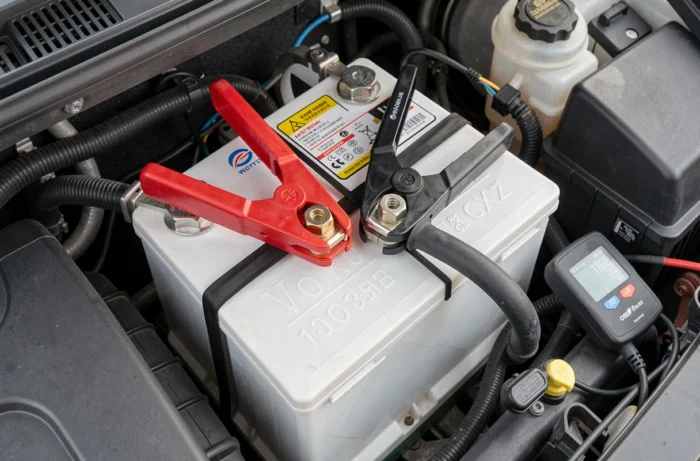
- An external auxiliary battery with clamps, a backup solution in the absence of a dedicated OBD enhancer. Check the polarity before any connection.
The cost of an OBD enhancer remains modest compared to the price of recalibration at a dealership after total loss of learning.
Resetting comfort and safety systems after battery change
Even with voltage maintenance, some functions require manual relearning. Power windows often lose their reference travel: the pinch protection mechanism does not work until the upper and lower stops have been re-recorded.
Window relearning procedure
Raise the window to the upper stop while holding the switch for two to three seconds after the movement stops. Then lower it completely while holding the switch. The procedure varies slightly by manufacturer, but this principle of full travel with holding at the stop is nearly universal.
The sunroof follows the same logic. Without resetting, the one-touch open function remains disabled.
Clock, radio, and dashboard settings
The clock automatically resynchronizes on vehicles equipped with an active GPS. On others, the setting is manual. The radio code, however, can lock the audio system. Retrieve the radio code before any intervention on the battery: it is found in the owner’s manual, on a dedicated card, or in the manufacturer’s online owner space.
Diagnostic tool and OBD scanner: when manual reset is no longer enough
On a vehicle that displays a persistent check engine light after battery change, a simple driving cycle will not solve the problem. The calculator has recorded a fault code (DTC) related to the voltage drop, and this code does not clear spontaneously on most current electronic architectures.
A diagnostic tool compatible with the vehicle’s brand allows for three distinct operations:
- Clearing fault codes generated by the power cut, including those related to passive safety modules (airbags, pretensioners).
- Starting the procedure to register the new battery in the BMS, providing the exact capacity and technology of the installed element.
- Forcing the relearning of engine idle and throttle position, which eliminates stutters and instability at idle speed.
An unstable idle that persists beyond a few dozen kilometers indicates a learning fault, not a mechanical problem. The scanner can distinguish between the two cases in a matter of seconds.
General-purpose tools like ELM327 cover reading and clearing engine DTCs. However, battery registration requires manufacturer-specific software or a professional-grade multi-brand tool capable of communicating with the energy management module.
Common mistakes when replacing a battery on a recent vehicle
Installing a battery of a different technology without modifying the BMS settings is the most common mistake. Installing an EFB battery instead of an AGM on a vehicle with Start-Stop leads to chronic overloading of the element because the AGM charging profile applies higher voltages.
Reversing the terminals, even briefly, can blow the main fuse protecting the onboard network and damage sensitive modules. On some vehicles, this reversal triggers a lockout of the engine calculator that requires dealership intervention.
Respecting polarity and the manufacturer’s battery specifications remains the primary preventive measure. The original part number, amp-hour capacity, and technology are listed on the label of the removed battery or in the service booklet.