
Installing a mobile home on private land seems like a quick solution to have a temporary accommodation or a leisure residence. The administrative reality is more restrictive than what manufacturers’ advertisements suggest. Between the three-month threshold, the requirements of the local urban planning plan, and the risks of fines, the process relies on precise legal distinctions that must be mastered before any purchase.
Mobile home and urban planning law: what the preservation of mobility means
The urban planning code classifies the mobile home among mobile leisure residences. This classification is based on a technical criterion that is often underestimated: the mobile home must permanently retain its means of traction. Wheels, axles, and towing bars must remain in place and in working order.
As soon as these elements are removed, or if the mobile home is placed on masonry blocks, connected to networks in a permanent manner, the structure falls into the category of constructions. It then falls under the regime of building permits or prior declarations, depending on its surface area, just like a single-family home.
This shift does not depend on the owner’s will or a declaration. It results from a factual observation, often made during a municipal inspection. This is the fundamental point on which the legislation and conditions for installing a mobile home fundamentally rely: the effective mobility of the structure determines the applicable legal regime.
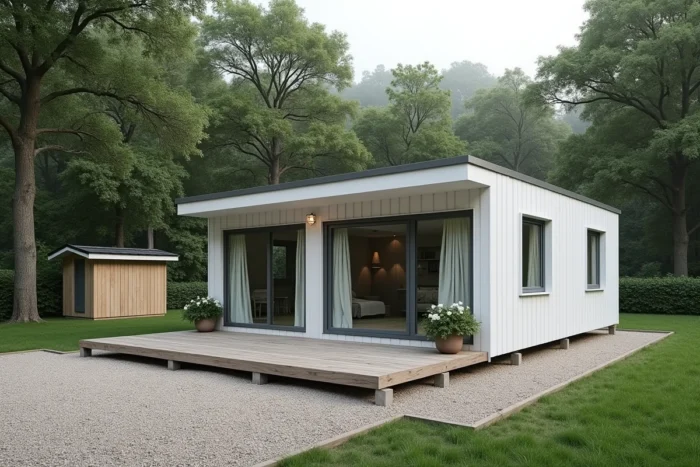
Three-month rule on private land: a threshold of tolerance, not an acquired right
The regulatory framework allows for the temporary installation of a mobile home on private land without formalities, provided that the duration does not exceed three months per calendar year. Beyond that, a prior declaration at the town hall becomes mandatory.
Recent feedback shows that town halls use this three-month rule as a strict limit of tolerance. During construction projects or temporary relocations, they systematically require a prior declaration once the threshold is exceeded, or even refuse the installation.
This three-month period is neither cumulative nor divisible at the owner’s convenience. If the mobile home remains on the land from June 1 to September 15, the quota is consumed. Replacing it in November for two weeks may constitute an overrun. The municipality’s urban planning rules may also completely prohibit this type of temporary installation, even below the three-month threshold.
Buildable or non-buildable land: two distinct regimes
On buildable land, the permanent installation of a mobile home requires compliance with the entire local urban planning plan (PLU). This includes rules on placement, height, distance to property boundaries, and external appearance. The Alur law of 2014 opened the possibility of installing a mobile home as a primary residence on private land, but this opening comes with the same obligations as a traditional construction.
On non-buildable land (agricultural, natural, or forested areas), the possibilities are extremely limited. Installation is only feasible within the framework of limited size and capacity sectors (STECAL), created by the PLU. These permits are granted sparingly and generally target specific agricultural or social needs, not individual leisure projects.
PLU and municipal inspections: the real financial risk of an unreported installation
Several municipalities have implemented an active policy of monitoring and penalizing mobile homes installed outside authorized structures. The penalties are not symbolic: fines are calculated per square meter of surface area, and notices for dismantling are systematic.
The violation can be observed in various ways: neighbor reports, photographic aerial surveys as part of the cadastral update, or inspections during a permit application for a neighboring plot. The statute of limitations in urban planning does not effectively protect the owner, as the presence of the mobile home on the land constitutes a continuous violation.
- An installation without a prior declaration beyond three months exposes the owner to a report of violation of the urban planning code and an obligation to restore the land.
- Unauthorized connections to networks (water, electricity, sanitation) may lead to additional prosecutions, distinct from the urban planning violation itself.
- The development tax and property tax may be claimed retroactively if the mobile home is requalified as a construction, significantly increasing the bill.

Property tax and taxation of mobile homes on private land
A mobile home retaining its means of mobility and installed for less than three months per year is generally not subject to property tax or development tax. The situation changes radically for a permanent installation on buildable land.
Mobile homes installed as primary residences on buildable land are increasingly fiscally assimilated to traditional constructions. Property tax applies, as does the development tax upon the first declared installation. The housing tax on secondary residences may also come into play if the mobile home is not the owner’s primary residence.
Sanitation and connections: often ignored obligations
A permanent installation requires connection to the collective sanitation network or, failing that, the establishment of a compliant non-collective sanitation system. This obligation generates costs for soil studies and installation that reduce the price gap between a mobile home and a traditional lightweight construction.
Electrical connection requires a request to the network manager, who will verify the compliance of the installation with current standards. Without a valid urban planning authorization, this connection may be refused.
Regulatory trend: a gradual tightening of PLUs
The recent trend in local urban planning plans is towards restricting the possibilities of lightweight housing on non-buildable land. STECAL permits are granted very selectively, and the chances of obtaining a mobile home permit through a simple individual request remain low.
This orientation is part of the logic of combating soil artificialization. Municipalities have broad discretion to refuse installation, even on buildable land, if the PLU provides for restrictions on use or appearance.
Before any project, the most reliable approach remains to consult the urban planning department of the relevant town hall to obtain an operational planning certificate. This document, issued within two months, indicates precisely whether the land can accommodate a mobile home and under what conditions. Purchasing a mobile home without this prior verification exposes the buyer to an unusable investment.